

There and Now, and After?
14/02/2026 - 24/04/2026
There and Now, and After?
İz Öztat
Zilberman Dialogues
February 14 – April 24 2026
Zilberman Dialogues, which seeks to establish a connection between the gallery’s exhibition spaces in Istanbul and Berlin, is pleased to announce There and Now, and After?, presented in parallel with İz Öztat’s solo exhibition Vorbei mit der Übeltäterei / Done with evil-doing at Zilberman | Berlin. A selection of Öztat’s recent works presented in the Berlin exhibition, will be on view from February 14 to April 22, 2026, on the second floor of Mısır Apartment.
In the selection of works exhibited in Istanbul, Öztat engages with traditional genres and themes of German-language literature, such as Kasperle puppet theater and the Faust myth, to explore how they are anchored in collective memory, co-opted by national ideologies, and continue to shape norms and modes of conduct in the present day. In so doing, she raises questions about artistic agency and complicity, obedience and disobedience, as well as demonization and punishment.
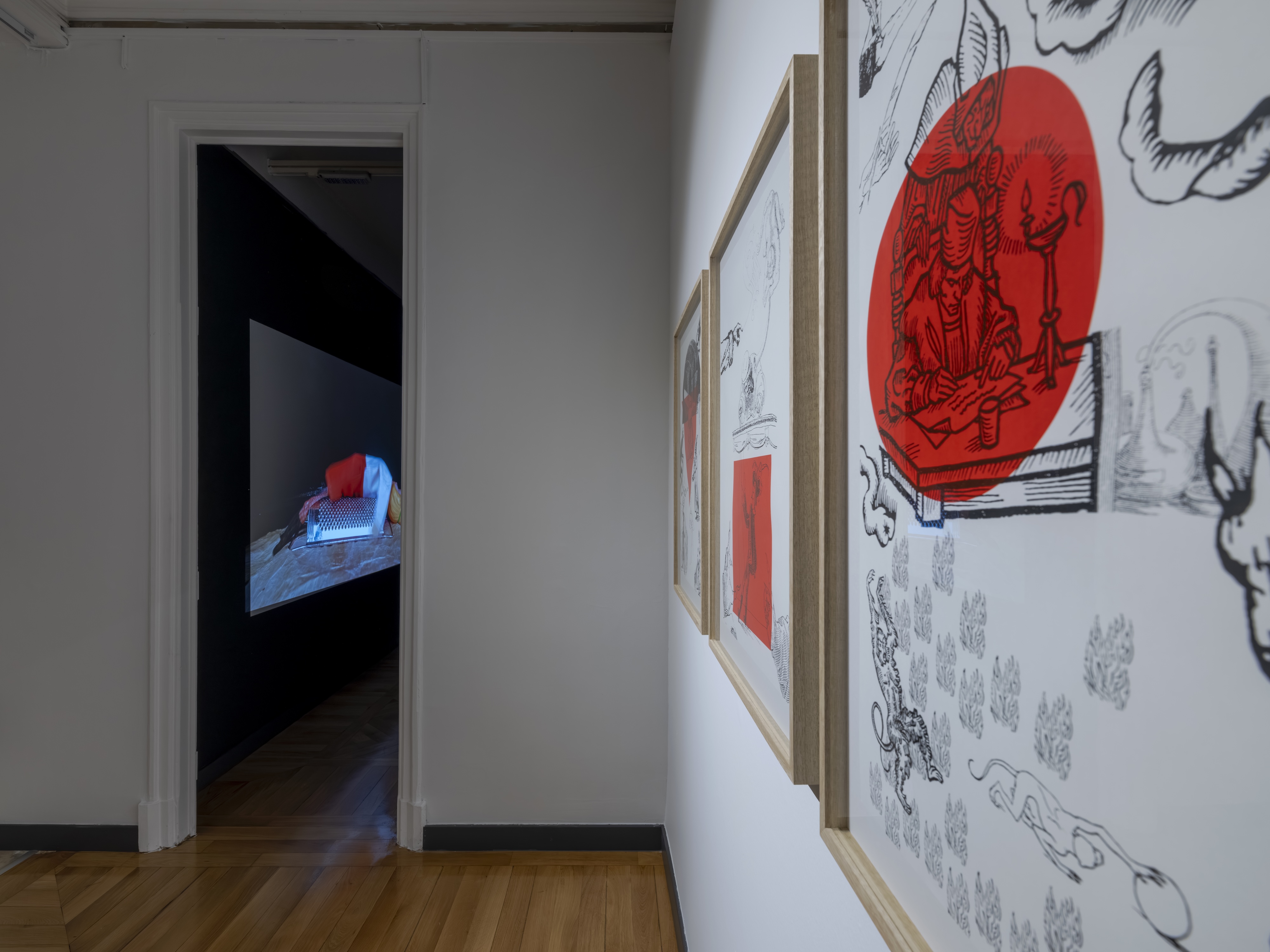
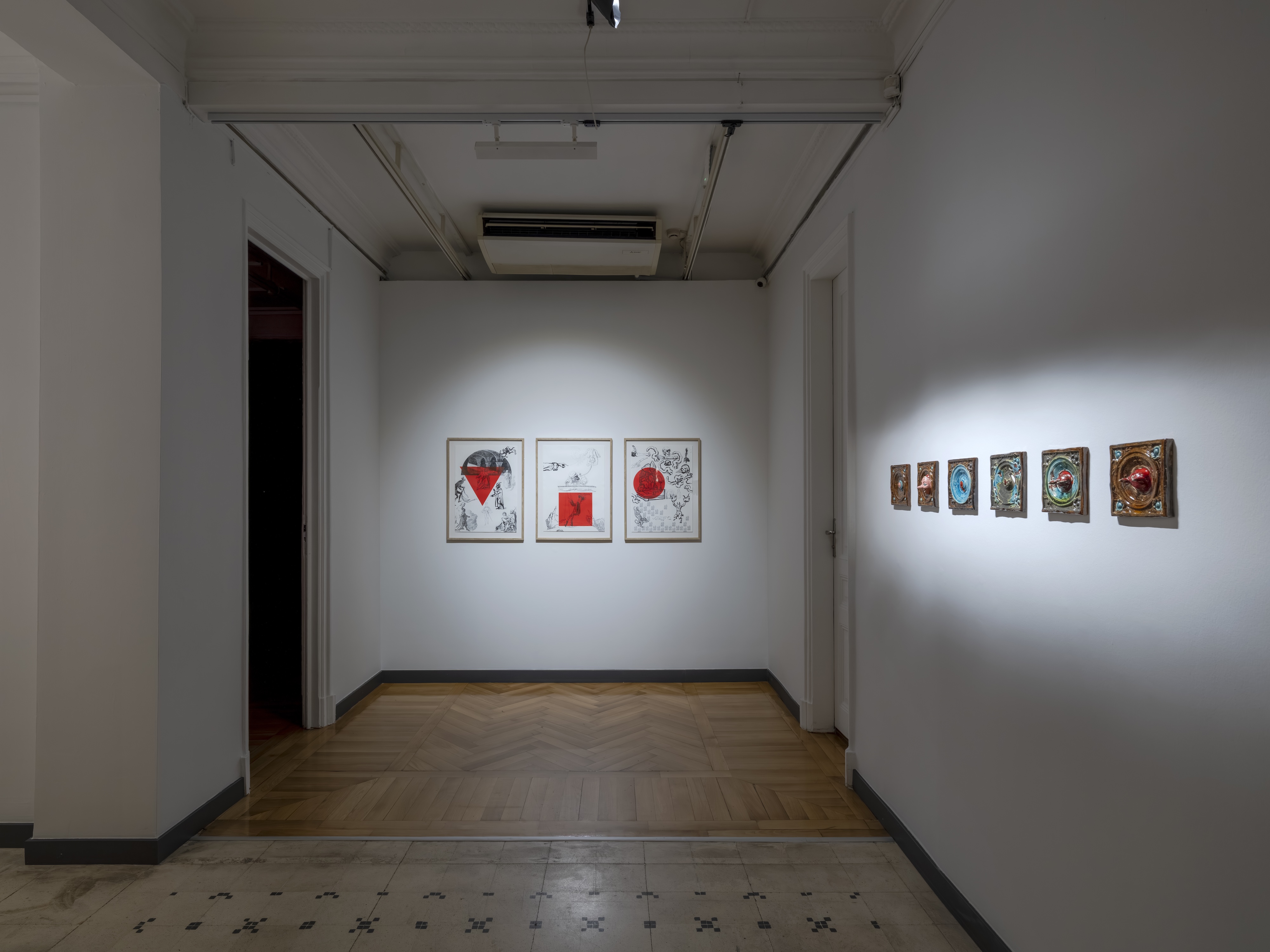
The triptych Studies for Faustian Bargain (2026) draws upon historical engravings and wood-cuts on the Faust legend, in particular illustrations to Goethe’s Faust. The various panels show the scholar in his study, as well as Mephisto, devils, and other allegorical motifs. Various hands intervene in the scenes – pointing, seducing, directing – as in a theatre of marionettes, thus representing Faust’s actions as directed from above and without agency. Faust moves between a thirst for knowledge, a vulnerability to influence, and abettal. Characteristic of a particular iconography that İz Öztat has developed over the years, red geometric forms appear. They establish viewing axes, allow for political associations, and frame Faust as a figure with limited leeway for discretion.
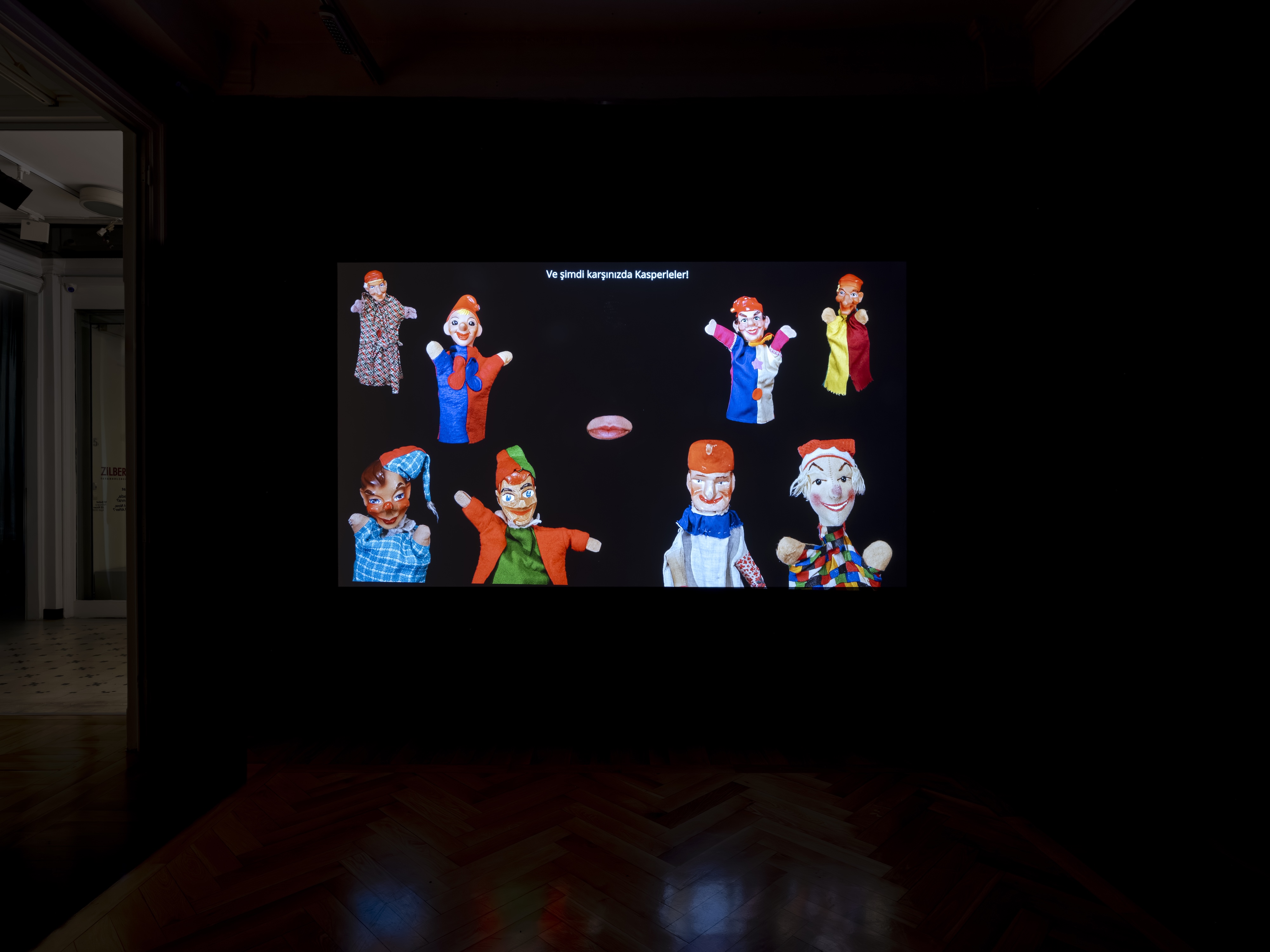
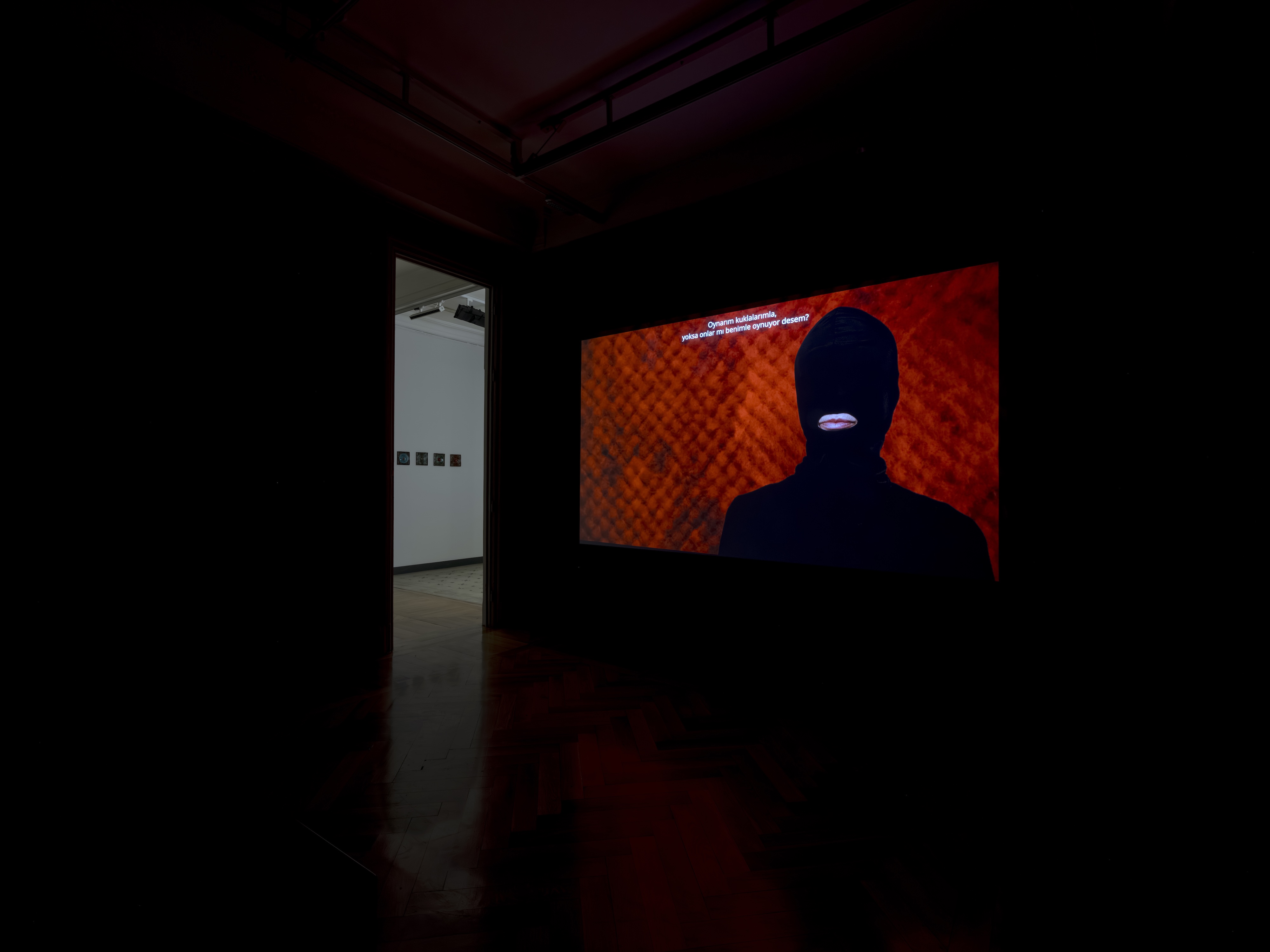
The red triangle re-appears in the video Here and Now, and After? (2025), in a humorous way, as the red, inverted triangle nose of a disobedient puppet. As a puppet play for the camera, this work deals with national narratives, emphasizing what they leave out and repress. Conventions from the Kasperle theatre, which has historically been a site of political satire, as well being instrumentalized as a pedagogical and ideological medium, are intertwined with elements of Karagöz shadow plays. The show’s action develops from the playing out of three contractual relationships: the Faustian pact with the devil, the artist’s pact with the state, and the negotiation of the desire to become a puppet. In these exchanges, consent, refusal, and negotiation – and thus questions relative to artists’ power to act, the institutional conditions of their work, and their accountability – become visible. While certain figures enter into agreements, others refuse to comply and demand justice on their own terms.
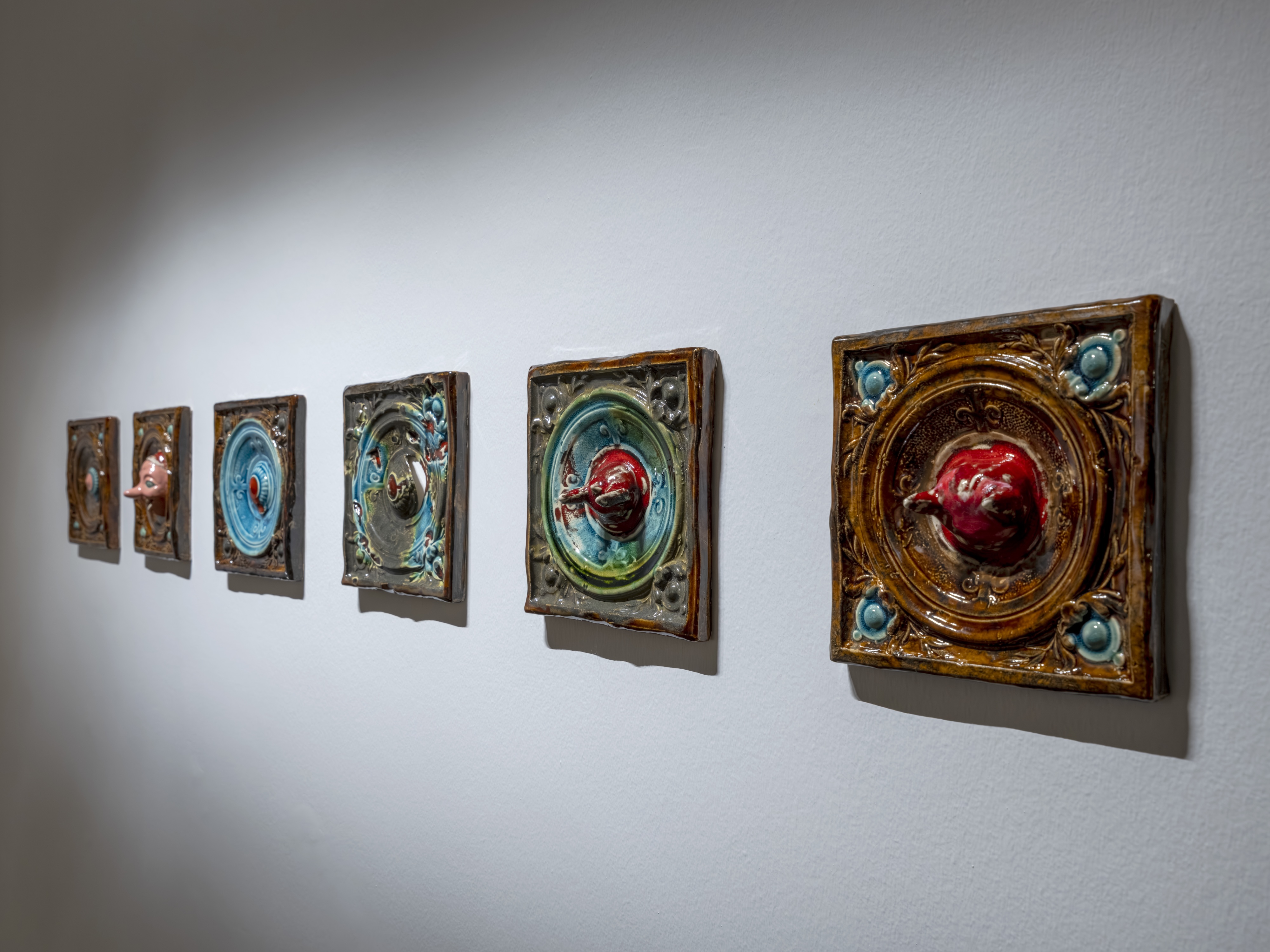
Öztat also produces site-specific works, responding to the bourgeois setting of the gallery in Berlin, located in a turn-of-the-century building. İz Öztat engages with the decorative surface of the tile stove found on site, by recasting one of the tiles and exhaustively reinterpreating it. From this site-specific body of work, a selection of tiles is exhibited in Istanbul. In this series, titled Exorcism, Kasperle and devil puppets, which the audience encounter also in other exhibited works, emerge from within the decorative surface.
A catalogue will be published in conjunction with the exhibition in Berlin, featuring an essay by Banu Karaca.
*Adapted from the text written by Lotte Laub for the exhibition in Berlin.
Translation from German to English: Darrell Wilkins
İz Öztat (born 1981 in Istanbul, lives and works in Berlin) studied Fine Arts and Visual Communication Design (MA) at Sabancı University, Istanbul, and Studio Art (BA, with honors) at Oberlin College, Ohio. She was a fellow of the Berlin Artistic Research Programme (2024–25). Her institutional exhibitions include Near East, Far West, 6th Kyiv Biennial, MSN, Warsaw (2025); these walls are not here to defend us, OFF-Biennale Budapest (2025); Self-Determination: A Global Perspective, Irish Museum of Modern Art, Dublin (2023), where her work is also part of the collection; The Colony, Schwules Museum, Berlin (2018); Sharjah Biennial 13 (2017); Land without Land, Heidelberger Kunstverein (2016); and the 14th Istanbul Biennial (2015). Öztat has been an artist-in-residence at the Swiss Institute Saha Residency (2025), the Istanbul–Berlin Residency Program (2022), and SAHA Studio, Istanbul (2021). She has worked at the intersection of art and education in self-organized, institutional, and academic settings. Her academic articles, essays, and fictional texts have been published in various media.
» SIEHE AUCH
Artist Pages
- İz Öztat
-
Installation View - Photo credit: Kayhan Kaygusuz -
Installation View - Photo credit: Kayhan Kaygusuz -
Installation View - Photo credit: Kayhan Kaygusuz -
Installation View - Photo credit: Kayhan Kaygusuz -
Installation View - Photo credit: Kayhan Kaygusuz