ETCETERA
13/08/2009 - 25/09/2009
Abstract Expressionism: (1940 – 1955)
Term applied to a movement in American painting that flourished in the 1940s and 1950s, sometimes referred to as the New York School.
Abstract Expressionism emphasized the depiction of emotions rather than objects. Most painters of the movement favored large canvasses, dramatic colors, and loose brushwork. The movement originated in New York’s Greenwich Village in the mid-1940’s and was also called action painting and the New York School. Emphasizing its independence from European art trends, Abstract Expressionism was the first American school to influence artists over seas rather than vice versa. Abstract Expressionism held prominence until the development of Pop Art in the 1960’s. The movement allowed New York to replace Paris as the center of the art world.
Although Abstract Expressionism encompassed an array of stylistic approaches, several unifying themes were present in the movement. Abstract Expressionist paintings consisted of shapes, lines, and forms meant to create a separate reality from the visual world. Technically, most abstract expressionists paid attention to the surface quality and texture and wished to emphasize the accident and chance in their work, but often highly planned their execution. So, mistakes that did occur during the painting process were used to the artist’s advantage. Arshile Gorky and Hans Hoffman were integral in calling artists’ attention to the physicality of paint and the potential for expression in abstraction. The two major types of Abstract Expressionism are Action Painting and Color Field Painting. Action painters such as Jackson Pollock wished to portray paint texture and the movement of the artist’s hand. Color Field painters such as Mark Rothko were concerned with color and shape in order to create peaceful and spiritual paintings with no representative subject matter.
Abstract Expressionists saw painting as a pure expression of emotion and means of visual communication. Not all Abstract Expressionist work was abstract and expressive, although the movement is united in its spontaneous release of unconscious creativity. The act of painting is considered as important as the finished product itself.
The philosophy of Abstract Expressionism searches for answers to the questions of human existence. It addresses personal psychological battles, the external struggle between man and nature, and the hunt for spiritual comfort. All of these concepts were expressed through abstraction, finding meaning in relating the act of painting with a release of subconscious feelings and desires. The movement had a profound impact on later generations of American artists, particularly in their use of color and materials
Color-field painting,
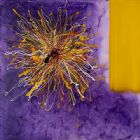
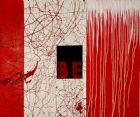
Color-field painting represents a sharp change from the earlier movement. The production of the abstract expressionists involved a strong personal emotionalism, a painterly quality, and occasionally, as in the works of Willem de Kooning, elements of cubism. Color-field artists moved toward a more impersonal and austerely intellectual aesthetic. In their works they dealt with what they considered to be the fundamental formal elements of abstract painting: pure, unmodulated areas of color; flat, two-dimensional space; monumental scale; and the varying shape of the canvas itself.
Action painting
Sometimes called "gestural abstraction",
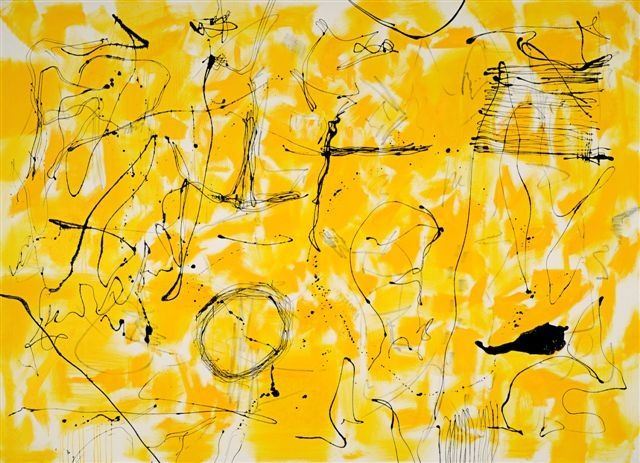
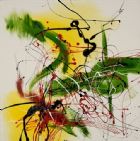
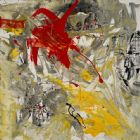
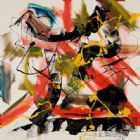
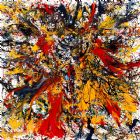
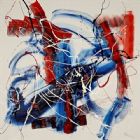
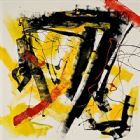
a style where paint is spontaneously dribbled, splashed or smeared onto the canvas, rather than being carefully applied. The resulting work often emphasizes the physical act of painting itself as an essential aspect of the finished work or concern of its artist. The finished painting being only the physical manifestation, a kind of residue, of the actual work of art, which was in the act or process of the painting's creation. This spontaneous activity was the "action" of the painter, through arm and wrist movement, painterly gestures, brushstrokes, thrown paint, splashed, stained, scumbled and dripped. The painter would sometimes let the paint drip onto the canvas, while rhythmically dancing, or even standing in the canvas, sometimes letting the paint fall according to the subconscious mind, thus letting the unconscious part of the psyche assert and express itself.
Hard-edge painting
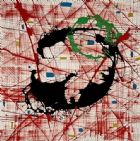
A style in which abrupt transitions are found between color areas. Color areas are often of one unvarying color. Color transitions often take place along straight lines, though curvilinear edges of color areas are also common. The Hard-edge painting style is related to Geometric abstraction, Op Art, Post-painterly Abstraction, and Color Field painting.
The term was coined by writer, curator and Los Angeles Times art critic Jules Langsner in 1959 to describe the work of painters from California, who, in their reaction to the more painterly or gestural forms of Abstract expressionism, adopted a knowingly impersonal paint application and delineated areas of color with particular sharpness and clarity. This approach to abstract painting became widespread in the 1960s, though California was its creative center.
» SIEHE AUCH
Artist Pages
- Jiri Kobos